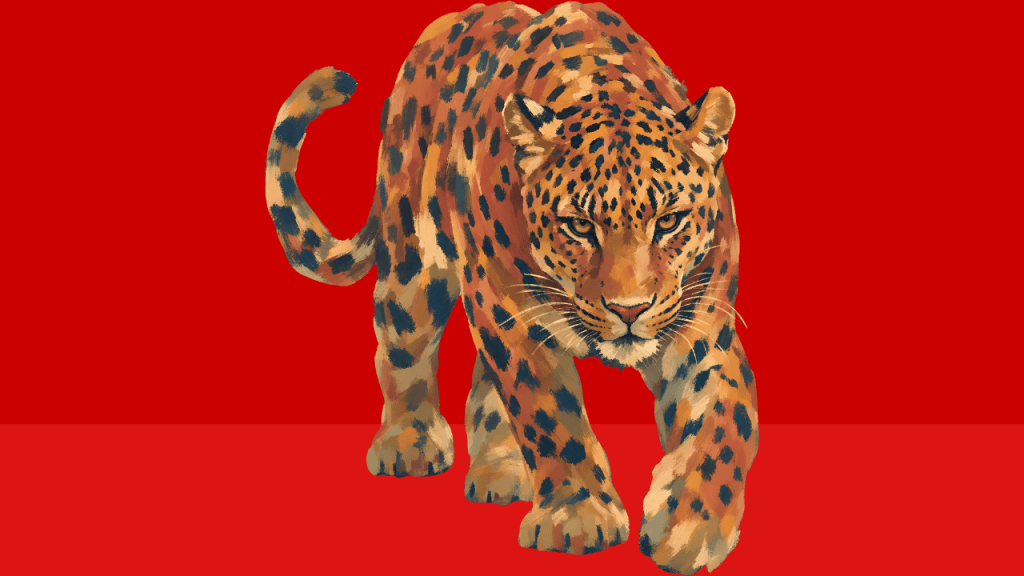

Leopard print is hot. Sexy. Tempting. Almost every woman that we want to be (or to be with) has at least one leopard print moment in the tabloids. There was also a time that it was tacky. Too much. Immodest. From the mafia to the madam’s house, people associated it with money that couldn’t be made in good moral standing and women who weren’t to be trusted.
Both times in fashion history share a problem: they dilute the message that leopard print wants to send because we live in a society that devalues women and devalues people of colour.
Once Dominant, Now Dismembered
African indigenous communities don’t see leopards the way we do. I think it’s partially because of our commodification culture that we see them that way. During colonialism, Western aristocrats could have the head of a wild cat brought to their homes, making them less dangerous and powerful and more of a “wonder” or “beauty”. So, hundreds of years before Shania Twain graces us with the That Don’t Impress Me Much music video, the commodification of leopard print begins.
Alongside this timeline, we see the same with women and people of colour. Desirée Gonzalez MA, SEED AP, TiD-B, a Social/Community Psychologist and founder of The Restorative Design Association, explains: “In order to take people away from their wholeness, you need to fragment them, and that’s part of this process. This is discussed in Kindred. This fragmentation and cutting away pieces of women, especially women of colour, for commodification. But I think it’s fascinating too this idea of civility. Because it’s those who need us to be “civilised” for there to be a sense of control.”
Many prominent African men cling to this symbol, chiefs, kings and modern politicians still wearing leopard print to portray the qualities of a good, *manly* leader. At the 2026 World Cup, Congo’s national team touched American soil in a way that made headlines. Black suits with leopard breastplates over their left lapels and a silver leopard brooch. The message was well received.
It’s feminisation isn’t new or wrong. In fact, the wearing of leopard print goes back to depictions of Seshat, the ancient Egyptian goddess of wisdom (Ralph, 2023). We’re just unfortunate enough to live in a modern world where people don’t commonly associate power, strength and bravery with a woman.
“Things get labeled as like masculine and feminine, and there definitely is like the masculine and feminine, right?” Desireé says. “But I think often it creates this sort of binary. All humans possess these things.”
The big cat made the catwalk in 1947. Christian Dior is the first to put the print in a show, saying of it: “If you’re fair and sweet, don’t wear it!” (Iqbal, 2018). This has since been true of the print. Fashion houses that still perpetuate this narrative include Roberto Cavalli, Versace, Dolce & Gabbana. And the work is truly fantastic but not without its pitfalls.
Sex, Submission And Shame
It’s when the print leaves the African anthropological and spiritual context that things get raunchy. Dionysus, the god of wine, takes the leopard print from wisdom to hedonism. Cybele, an Anatolian (modern day Turkey) cult goddess of fertility is also pictured in the print. These prints were carried through the roaring 20s by stars like Eartha Kitt and Jospehine Baker: sex symbols of their time and sex symbol movie stars of the 50s Marilyn Monroe and Ava Gardner carry the flame. (Ralph, 2023). It then becomes a mark of shame in the 90s when animal rights groups like PETA crack down on its use at shows and cultural puritans crown it the print of obscenity.
“It’s interesting that it was demonised and sexualised back in the ’90s,” Desireé comments. “Female sexuality was a thing but not in a way where it was empowering. It was very much for the male gaze but if you look at the contrast of indigenous cultures, animal skins were used in a reverent way. There needs to be a re-reverence of life and animals and the natural world in Western culture, and then we can see a shift in our fashion.”
The concern today is that we’re going backwards. As fascism and traditional gender roles are back on the rise, brands turn from predator prints to prey prints, pushing docile animals like deer, zebras and cows.
Desireé argues that this and the returning pressure of “thinness” mirrors our social psychology: “The shift from predator prints to prey prints is fascinating to me. I think in building upon being underestimated and devalued, I think it culturally speaks to what’s happening with women. I think the cultural zeitgeist is women needing to be submissive, or the desire for women in the culture to be submissive as another form of control. Because when you have submissive, docile women, they’re easier to control. Cows, zebras—they’re definitely passive animals—that’s required of women now.”
Is Leopard Sexy Or Strong?
The shift in our own time suggests that the “tacky” or even “slutty” narrative on leopard print is retired. But in a time where being bold and advocating for yourself is essential both verbally and through art forms, we need it to be more than “sexy in a good way”. The real challenge is: in a culture that is insistent on the print occupying one definition at a time, how do you have it all?
“The first thing that came to mind for me was Women Who Run with the Wolves. So with that, I almost feel as though this [trend of leopard print] is mirroring us reclaiming the wild woman within ourselves. We need to reclaim the things that have been derogatory, like sexuality being this animalistic thing and it being this really negative connotation,” Desireé argues. She continues: “The reclamation of female power, our prowess, our fierceness, our primalness. I think that could help resurface the traits that have been watered down, especially when it comes to the underestimation of women of colour. Reclaiming our animalistic nature is a refusal of submission.”
References
Ralph, J. (2023). LEOPARD PRINT IN FASHION: A SPOTTED CULTURAL HISTORY. Underground England. Available at: https://underground-england.com/leopard-print-in-history/ (Accessed 24/08/2026)
Iqbal, N. (2018). Why animal prints are prowling the high street. The Guardian. Available at: https://www.theguardian.com/fashion/2018/oct/21/women-go-wild-for-leopard-skin-to-show-they-are-not-prey (Accessed 24/08/2026)
 Cheyenne A. Brown